Picture this.
It’s the Tuesday before Thanksgiving. You’ve planned your dinner, bought the ingredients, and perhaps even picked out your favorite serving dishes.
Then you open the refrigerator.
Your turkey is still frozen solid.
Oh, no.
If that’s ever happened to you, you’re definitely not the only home cook who’s worried about Thanksgiving preparations.
Hi, I’m Sarah Bennett, and today I’m going to help you figure out exactly how long it takes to thaw a turkey safely, whether you have several days or need a faster solution.
The good news? You don’t need to guess.
Once you know your turkey’s weight, planning becomes much easier.
Let’s start with the quick answer.
Quick Answer: How Long Does It Take to Thaw a Turkey?
For refrigerator thawing, allow approximately 24 hours for every 4–5 pounds of turkey.
For cold-water thawing, allow approximately 30 minutes per pound, changing the cold water every 30 minutes.
Here are the general times recommended by FoodSafety.gov.
| Turkey weight | Refrigerator thawing | Cold-water thawing |
|---|---|---|
| 4–12 pounds | 1–3 days | 2–6 hours |
| 12–16 pounds | 3–4 days | 6–8 hours |
| 16–20 pounds | 4–5 days | 8–10 hours |
| 20–24 pounds | 5–6 days | 10–12 hours |
These are planning estimates, not a reason to leave the turkey at room temperature.
Source: FoodSafety.gov Turkey Thawing Chart.
Method 1: Thaw Your Turkey in the Refrigerator
This is the method I’d recommend whenever you have enough time.
Refrigerator thawing is convenient because your turkey stays at a controlled, safe temperature while it defrosts.
And unlike the cold-water method, you don’t have to stay nearby changing water throughout the day.
What You’ll Need
- Your frozen turkey
- A sturdy roasting pan or rimmed tray
- Space on the bottom shelf of your refrigerator
- A refrigerator maintained at 40°F (4°C) or colder

Step 1. Check the Turkey’s Weight
Find the weight printed on the packaging.
If your turkey weighs 15 pounds, you should plan on approximately three to four days in the refrigerator.
If it’s 20 pounds, allow about four to five days, and consider giving yourself an additional buffer.
Step 2. Place the Wrapped Turkey on a Tray
Keep the turkey in its original wrapping.
Place it in a roasting pan or on a sturdy rimmed tray to catch any liquid that may escape.
Put it on the bottom shelf, away from ready-to-eat foods.
This helps reduce the risk of raw turkey juices contaminating other ingredients.
Step 3. Let It Thaw Slowly
Leave the turkey in the refrigerator for the recommended time.
Don’t put it on the counter to speed things up.
And don’t move it somewhere warmer because the middle still feels icy.
Slow, controlled thawing is the point of this method.
Step 4. Check Before Cooking Day
Once the turkey has thawed, it should no longer have a hard frozen center.
Check whether you can remove the neck and giblets from the cavities, and whether the legs move freely.
If it’s still partly frozen, keep it refrigerated until thawed or use an appropriate safe method to finish thawing.
Sarah’s tip: A turkey thawed in the refrigerator can generally stay refrigerated for an additional one to two days before cooking.
That little scheduling cushion can make Thanksgiving morning much more relaxed.
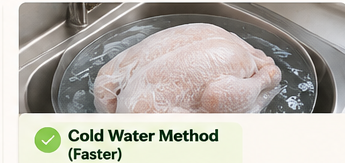
Method 2: Thaw Your Turkey in Cold Water
What if you don’t have three or four days?
Perhaps you forgot to move the turkey from the freezer.
Or maybe you bought it later than planned.
Cold-water thawing can be a useful alternative.
But there’s one important difference from refrigerator thawing:
You need to pay attention to the process, and you must cook the turkey immediately after it has thawed.
What You’ll Need
- A frozen turkey in leakproof wrapping or a sealed food-safe bag
- A clean sink or large container
- Cold tap water
- A way to keep track of 30-minute intervals

Step 1. Make Sure the Packaging Doesn’t Leak
The turkey must be completely enclosed.
If its original wrapper is damaged or not watertight, place it inside a suitable leakproof bag.
This helps protect the turkey from contamination and prevents it from absorbing water.
Step 2. Submerge the Turkey in Cold Water
Place the packaged turkey in a clean sink or large container.
Cover it completely with cold tap water.
Never use warm or hot water.
The goal is to thaw the meat while keeping the environment cold enough to reduce food safety risks.
Step 3. Change the Water Every 30 Minutes
This part matters.
Set a timer and replace the water every 30 minutes to keep it cold.
For a 12-pound turkey, the process will take roughly six hours.
For a 16-pound turkey, expect around eight hours.
So although this is faster than refrigerator thawing, it isn’t a method you should start and leave unattended overnight.
Step 4. Cook the Turkey Immediately
Once the turkey is completely thawed, prepare it for cooking.
Don’t put it back in the refrigerator planning to roast it two days later.
The USDA recommends cooking poultry immediately after cold-water thawing.
Wash your hands and thoroughly clean and sanitize the sink and any surfaces that may have contacted raw turkey juices.
When Should You Start Thawing for Thanksgiving 2026?
Thanksgiving falls on Thursday, November 26, 2026.
Here’s a practical refrigerator-thawing plan.
| Turkey weight | Suggested start date |
|---|---|
| 8–12 pounds | Monday, November 23, or earlier |
| 12–16 pounds | Sunday, November 22, or earlier |
| 16–20 pounds | Saturday, November 21, or earlier |
| 20–24 pounds | Friday, November 20, or earlier |
These suggested dates leave approximately the time needed to thaw within each weight range. Starting a day earlier gives you more flexibility, especially with a larger bird.
Keep the turkey refrigerated throughout.
My advice? Plan backward from the day you want to roast it, not the day you want to start preparing dinner.
A little planning now can prevent an unpleasant surprise later.
Can You Thaw a Turkey on the Counter Overnight?
No.
Even when the center of a turkey remains frozen, the outside may warm into a temperature range where harmful bacteria multiply.
That’s why kitchen-counter thawing isn’t recommended.
The same applies to leaving a turkey in a garage, on a porch, or in warm water.
Use the refrigerator, cold water, or an appropriate microwave method instead.
Can You Thaw a Turkey in the Microwave?
Yes, if your microwave is large enough and its manufacturer provides instructions suitable for the turkey’s size.
Follow those instructions carefully.
Remove any packaging that isn’t microwave-safe.
Because microwave thawing can warm parts of the turkey unevenly, you must cook the turkey immediately afterward.
For a large Thanksgiving turkey, I generally prefer refrigerator thawing or the cold-water method when practical.
They’re easier to plan around.
What if Your Turkey Is Still Frozen on Thanksgiving Morning?
First, don’t panic.
You still have options.
If it’s only partly frozen and you have enough time, you can finish thawing it safely using the cold-water method.
If it’s completely frozen, you can also roast a turkey directly from frozen using an appropriate oven method.
According to FoodSafety.gov, cooking from frozen generally takes at least 50% longer than cooking a fully thawed turkey.
Don’t use an oven bag for this method.
As the turkey warms, remove the giblet packet when it becomes possible to do so safely.
And as with any turkey, use a thermometer to verify that the thickest part of the breast and the innermost parts of the thigh and wing reach at least 165°F (74°C).
You can find more information in FoodSafety.gov’s guide to handling a turkey that isn’t ready on Thanksgiving.
The key is not to improvise with unsafe thawing shortcuts.
What to Do Once Your Turkey Is Thawed
Now we’re getting to the enjoyable part!
Once your turkey has thawed, you’re ready to season and roast it.
I like a straightforward combination of rosemary, thyme, garlic, olive oil, lemon, and black pepper.
You don’t need dozens of ingredients to make a delicious Thanksgiving dinner.
My companion guide, How to Roast a Juicy Thanksgiving Turkey: Easy Step-by-Step Recipe, walks you through preparing the bird, seasoning it, checking roasting times, using a food thermometer, and carving it after cooking.
And if you’re still planning what to serve alongside it, my collection of 100 Healthy Thanksgiving Recipes for the Whole Family includes plenty of ideas for vegetables, stuffing, breads, desserts, and more.
Frequently Asked Questions About Thawing a Turkey
How long does a 12-pound turkey take to thaw in the refrigerator?
Plan on approximately three days, with an extra buffer if possible. The general rule is about 24 hours for every four to five pounds.
How long does a 20-pound turkey take to thaw?
A 20-pound turkey usually needs around four to five days in the refrigerator. In cold water, allow approximately ten hours, replacing the water every 30 minutes.
Can I leave a thawed turkey in the refrigerator for two days?
Yes. A turkey thawed safely in the refrigerator can generally be kept there for an additional one to two days before cooking.
Can I use warm water to thaw a turkey faster?
No. Use cold tap water and change it every 30 minutes. Warm-water thawing can allow the outside of the turkey to become unsafe while the center remains frozen.
Do I have to cook a cold-water-thawed turkey right away?
Yes. Cook it immediately after thawing.
Can I refreeze a turkey after thawing it?
A turkey thawed in the refrigerator can be refrozen safely, although some quality may be lost. Turkey thawed in cold water or the microwave should be cooked before refreezing.
Sarah’s Final Thanksgiving Reminder
Here’s what I want you to remember.
The secret to a less stressful Thanksgiving isn’t cooking faster. It’s planning a little earlier.
Check your turkey’s weight.
Look at your calendar.
Choose a safe thawing method.
And give yourself enough time to enjoy preparing the meal rather than worrying about whether dinner will be ready.
If your turkey is already sitting safely in the refrigerator, you’re off to a great start.
Happy Thanksgiving, and happy cooking!
Sarah Bennett
Healthy Family Kitchen
Leave a Reply