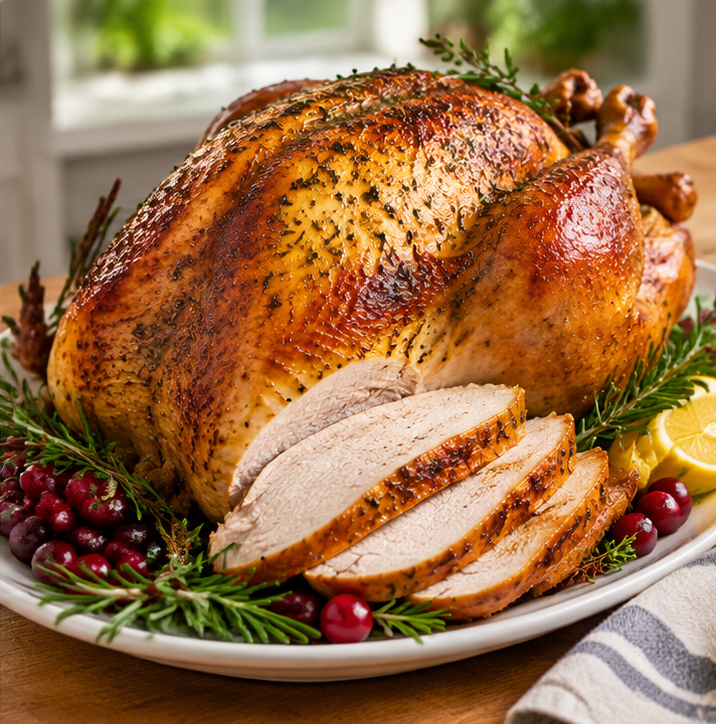
There’s something wonderful about opening the oven on Thanksgiving and seeing a beautifully golden turkey, with the smell of rosemary, garlic, and roasted herbs filling your kitchen.
But if you’re cooking Thanksgiving dinner for the first time, I know that moment can feel a long way off.
You might be wondering:
How long should I roast the turkey? What if it dries out? How do I know when it’s done?
Hi, I’m Sarah Bennett, and today I’m going to walk you through how to roast a juicy Thanksgiving turkey, one manageable step at a time.
We’ll use simple ingredients, a straightforward roasting method, and a meat thermometer so you don’t have to guess.
And here’s my first piece of advice: You don’t need an elaborate recipe to prepare a lovely Thanksgiving dinner. A good turkey, a few herbs, and careful cooking can go a long way.
Quick Recipe Overview
| Recipe | Herb-Roasted Thanksgiving Turkey |
| Turkey size | 12–14 pounds |
| Preparation | About 20–30 minutes |
| Oven temperature | 325°F (163°C) |
| Approximate roasting time | 3–3¾ hours, unstuffed |
| Resting time | 20–30 minutes |
| Safe internal temperature | 165°F (74°C) |
Important: The cooking time is only a guide. Always use a food thermometer to check doneness.
Ingredients You’ll Need
For a simple, flavorful Thanksgiving turkey, gather:
- 1 whole turkey, about 12–14 pounds, fully thawed
- ¼ cup olive oil
- 2 tablespoons fresh rosemary, finely chopped
- 2 tablespoons fresh thyme, finely chopped
- 4 garlic cloves, minced
- 2 teaspoons kosher salt, or to taste depending on whether the turkey is pre-brined
- 1 teaspoon freshly ground black pepper
- 1 lemon, halved
- 1 onion, quartered
- 1 cup low-sodium chicken or turkey broth, optional for the roasting pan
You’ll also need a roasting pan with a rack, paper towels, a food thermometer, and aluminum foil if the skin browns too quickly.
Sarah’s tip: Check the package before adding salt. Some turkeys have already been treated with a salt solution, and you may need less seasoning.

Step 1. Make Sure Your Turkey Is Completely Thawed
Before we do anything else, check that your turkey has fully thawed.
If it’s still frozen in the middle, it may take much longer to roast than you expect.
For refrigerator thawing, plan on roughly 24 hours for every 4–5 pounds of turkey.
A 12–14-pound turkey generally needs around three to four days in the refrigerator.
Keep it wrapped and placed on a tray on the bottom shelf to catch any drips.
If you’re short on time, my separate guide to safely thawing a Thanksgiving turkey explains what you can do.
Never thaw a turkey on the kitchen counter.
Step 2. Prepare Your Oven and Roasting Pan
Preheat your oven to 325°F (163°C).
Place an oven rack low enough that the turkey will fit comfortably in the center of the oven without touching the heating elements or the top.
Set a roasting rack inside a large pan.
Remove the wrapping from your thawed turkey, checking both cavities for the neck and giblets. Save those for stock or gravy if you like.
Do not rinse the raw turkey. Washing poultry can splash bacteria around your kitchen.
Instead, use paper towels to pat the skin dry, then discard the towels and wash your hands thoroughly.
Dry skin helps the surface brown more evenly.
Step 3. Make the Garlic and Herb Mixture
In a small bowl, mix the olive oil, rosemary, thyme, garlic, pepper, and appropriate amount of salt.
The mixture should look like a fragrant herb oil.
Rub it gently over the turkey skin, including the legs and wings.
You can also carefully loosen some skin over the breast and spread a little seasoning underneath, without tearing it.
Place the lemon halves and onion quarters loosely inside the cavity for aroma. They aren’t stuffing intended for eating.
I prefer cooking bread stuffing separately. It’s simpler to manage and helps you avoid having to monitor the temperature inside a stuffed turkey.

Sarah’s Little Thanksgiving Trick
Prepare your herb mixture before you begin handling the raw turkey.
That way, you’re not repeatedly opening spice jars with messy hands.
Small details like this make holiday cooking much easier!
Step 4. Roast the Turkey
Place the turkey breast-side up on the roasting rack.
If desired, pour a little broth into the bottom of the pan, keeping the turkey elevated above the liquid.
Transfer the pan to your preheated oven.
For an unstuffed 12–14-pound turkey, allow approximately 3–3¾ hours.
Resist the urge to open the oven door every few minutes. Each time you do, heat escapes.
You don’t need to baste constantly. If the skin begins browning too quickly, loosely cover the top with aluminum foil.
Start checking the internal temperature before the lower end of the estimated cooking window.
Thanksgiving Turkey Roasting Times by Weight
These are approximate times for fully thawed, unstuffed whole turkeys roasted at 325°F.
| Turkey weight | Approximate roasting time |
|---|---|
| 8–12 lb | 2¾–3 hours |
| 12–14 lb | 3–3¾ hours |
| 14–18 lb | 3¾–4¼ hours |
| 18–20 lb | 4¼–4½ hours |
| 20–24 lb | 4½–5 hours |
Source: FoodSafety.gov Turkey Roasting Chart.
Every oven and turkey is a little different. These times help with planning, not with deciding whether the meat is safe to eat.
Step 5. Check the Internal Temperature
This is the step I never want you to skip.
Insert your food thermometer into:
- The thickest part of the breast
- The innermost part of the thigh
- The innermost part of the wing
Avoid touching bone with the thermometer probe.
All three locations must reach at least 165°F (74°C).
If one area isn’t ready, return the turkey to the oven and check again.
Don’t rely on skin color, clear juices, or the pop-up timer alone.
A food thermometer is your most reliable tool.
Step 6. Let the Turkey Rest Before Carving
Once the turkey has reached the required temperature, carefully remove it from the oven.
Transfer it to a serving platter or leave it in the roasting pan and let it rest for about 20–30 minutes.
This gives the meat time to settle before carving and makes it easier to handle.
Meanwhile, you can finish heating your Thanksgiving side dishes or prepare the gravy.
When you’re ready, remove the legs and wings, slice the breast meat, and arrange everything on a platter.

How to Keep Your Thanksgiving Turkey Juicy
The most common worry about roasting a turkey is ending up with dry breast meat.
Here are my favorite practical reminders.
Use a thermometer. Overcooking is one of the easiest ways to dry out turkey, so check the temperature instead of waiting for an arbitrary cooking time.
Season the turkey thoroughly. Herbs, garlic, lemon, and olive oil add flavor without needing a complicated marinade.
Don’t roast at unnecessarily high heat. Our 325°F method gives you a predictable starting point.
Let the meat rest. Don’t rush straight from oven to carving board.
Serve with a little pan juice or gravy. Even beautifully cooked turkey tastes better with a flavorful accompaniment.
And don’t panic if the finished turkey isn’t magazine-perfect.
If it’s safely cooked, flavorful, and enjoyed around your family table, you’ve already accomplished something wonderful.
What to Serve With Roast Thanksgiving Turkey
Now for my favorite part: building the rest of the meal.
Herb-roasted turkey pairs beautifully with garlic mashed potatoes, roasted Brussels sprouts, cranberry sauce, whole-wheat dinner rolls, and apple-and-sage stuffing.
If you’re still deciding what to prepare, take a look at my collection of 100 Healthy Thanksgiving Recipes for the Whole Family. It includes main dishes, vegetable sides, stuffing, breads, desserts, and ways to use Thanksgiving leftovers.
Frequently Asked Questions
Should I cover my turkey while roasting?
You can roast it uncovered and loosely tent the skin with foil if it begins to brown too quickly. Avoid wrapping it tightly throughout cooking unless you’re following a method designed for that.
Is it better to roast a turkey at 325°F or 350°F?
Both can be used in appropriate recipes. This guide uses 325°F because it aligns with the official roasting-time chart provided by FoodSafety.gov.
How do I know when my turkey is fully cooked?
Check the thickest part of the breast and the innermost parts of the thigh and wing. All must reach at least 165°F.
Can I prepare the herb mixture in advance?
Yes. Prepare it ahead and refrigerate it in a covered container. If using olive oil, allow it to soften enough to spread when you’re ready to season the turkey.
What should I do with leftover turkey?
Refrigerate leftovers within two hours. Store them in shallow containers and use refrigerated leftovers within three to four days, or freeze them.
A Final Word From Sarah
Thanksgiving cooking doesn’t have to be a competition.
You don’t need a professional kitchen, twenty expensive ingredients, or a perfect-looking turkey.
Start with good preparation. Give yourself enough time. Use your thermometer.
And remember to enjoy the people you’re cooking for.
That’s what makes a Thanksgiving meal special.
My little challenge for you: Before Thanksgiving morning, check that your turkey is thawing safely, your thermometer works, and your roasting pan fits in the oven.
Those three simple preparations can save you a lot of stress later.
Happy Thanksgiving!
Sarah Bennett
Healthy Family Kitchen
Leave a Reply